
Grief Tools for Men #3: Be the Jaguar and Face It
The Hardest Thing You’ll Ever Do is the Only Way Forward

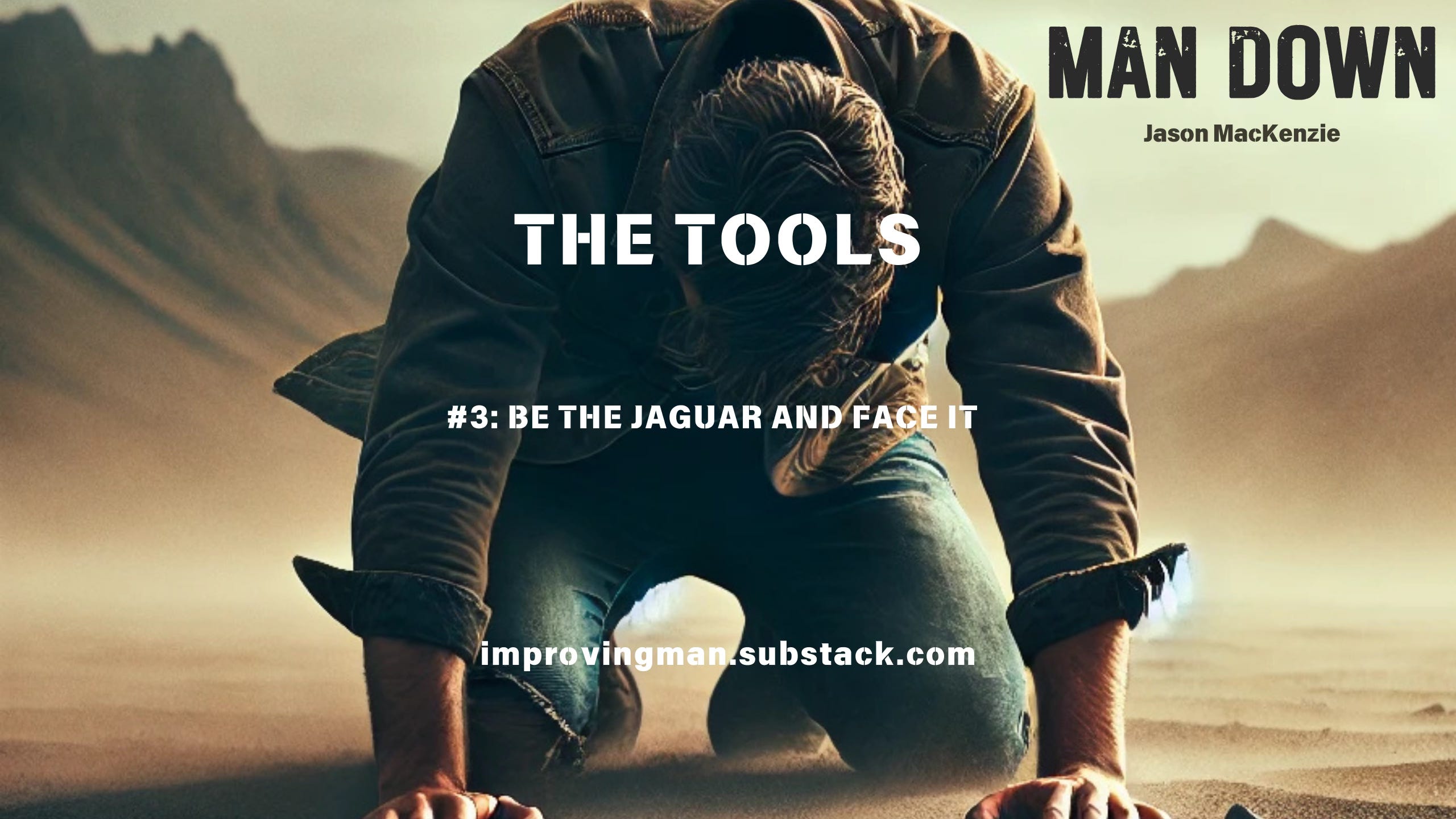
We were in the middle of a traditional Indigenous sweat lodge ceremony in the jungles of Costa Rica. Eighteen of us, packed inside a small wooden frame covered with heavy blankets. In the center, a shallow pit held red-hot stones, carried in from the sacred fire outside. The structure was meant to represent the womb of Grandmother Earth—a symbol of rebirth and purification.
It might have represented a womb, but it felt more like a furnace.

Jammed in so tightly we could barely move. Hotter than any sauna I’d ever been in. The air was thick, heavy—so suffocating it felt like I was breathing through a soaked towel. Pitch black. No light, no way to orient yourself, just the relentless heat and discomfort pressing in from every angle.
People were crying. Some were hyperventilating, panicking, and heading toward the exit. Others just sat there, silent, locked in their own personal war.
I wanted out.
The rocky dirt floor beneath me had turned to mud from all the water being poured over the stones. My back was completely spasming from being hunched over for so long, the pain radiating up my spine like an exposed nerve. I could feel every muscle in my body begging to stretch, to move—to escape.
Before the ceremony began, the shaman had told us something.
“This ceremony will bring up whatever you’ve been avoiding. Thoughts. Emotions. Things buried so deep you might not even know they’re there.”
And then he gave us a choice.
“You can get up and walk out. Or you can stay. You can face it.”
Then he told us about the jaguar—the apex predator of this region. It never runs. Never cowers. When it hears a noise in the jungle, it doesn’t flinch or hide. It turns and faces it. Confident. Unshaken.
That, he told us, was our challenge. Be the jaguar.
Sit in the fire. Face whatever appears.
I sat there, my head pressed against my knees, whispering to myself, Be the jaguar. Be the jaguar.
Because the jaguar doesn’t run.
The jaguar doesn’t shrink back.
The jaguar faces what’s coming.
And that’s what I did.
Why This Matters (And Why It’s So Hard)
Grief doesn’t ask if you’re ready. It doesn’t wait until you have time for it. It kicks the door in whenever it damn well pleases.
And when it does, you don’t get to calmly weigh your options. You don’t sit there thinking, Do I want to face this or avoid it?
No. It hits like a tidal wave.
One minute, you’re standing in the kitchen, making coffee. The next, you’re gripping the counter, trying not to collapse. You’re in the grocery store, and suddenly you feel like you might throw up, but you don’t even know why. You’re lying in bed, and your mind is running a highlight reel of every single moment you’ll never get back.
You don’t choose to face grief. You survive it when it comes for you.
And here’s the part no one warns you about—it feels like hell.
Facing it doesn’t look like a moment of quiet reflection. It’s not just shedding a few tears and feeling lighter afterward. It’s being curled up on the floor, clutching your child’s urn, shaking so hard your ribs ache. It’s feeling rage so overwhelming that you need to punch the wall just to prove you still exist. It’s crying so hard you gag, spit running down your chin, unable to pull yourself together.
And in those moments, you don’t feel strong. You feel pathetic. Weak. Like you’re failing the people who still need you.
And the fear? It’s not just the pain itself—it’s the thought that if you really let yourself feel it, you’ll never come back. That if you let go, you’ll fall into a pit you can never climb out of.
That’s the biggest lie grief tells you.
Because it doesn’t work that way.
The wave will hit. It will feel like it’s too much. You’ll feel like you’re about to break.
And then?
The wave will move. The breath will come back. The ground will still be there.
You don’t have to hold it together to survive this. You just have to stop running.
The Words You Use Matter
We’ve already talked about the power of words. How they don’t just describe your reality—they define it.
For a long time, I used to tell myself to fully experience my emotions when they hit. It sounded like the right thing to do—leaning in, letting it happen.
But something about that phrase felt weak. Passive. Like I was letting myself get dragged under instead of standing my ground. It made me want to avoid what was happening because I was so fucking sick of having to “experience it.”
So I changed the words.
Now, I tell myself to face it.
And here’s the thing—I didn’t actually do anything different. It was all internal. The words changed, and suddenly, I had strength I didn’t have before. I could sit with whatever came up because I wasn’t just experiencing it.
When I think of myself facing it, I imagine myself squaring my shoulders, stiffening my spine, and turning towards what I most want to avoid.
Your words shape your beliefs. Your beliefs shape your actions. And your actions shape your reality.
If you tell yourself you’re drowning, your brain will believe it.
If you tell yourself you’re facing it, your brain will believe that too.
Choose wisely.
This mantra became so powerful for me that I had it inked into my skin. A jaguar, tattooed on my arm—a permanent reminder to never run. To turn. To face it. To be the jaguar.

The Three Biggest Mistakes Men Make
1. Believing That Avoiding It Will Make It Go Away
You tell yourself you’re fine because you can function. Because you show up for work. Because you get through the day without breaking down.
But look closer.
You snap at your wife for no reason. You sit in your car after work, scrolling mindlessly on your phone because you don’t want to go inside. You wake up exhausted, even when you get a full night’s sleep. You avoid certain places, certain songs, certain memories like they’re landmines.
The weight? It doesn’t leave. And the longer you carry it, the heavier it gets.
Grief doesn’t disappear just because you shove it down. It waits. And when it finally comes back? It’s stronger.
2. Fighting Reality Instead of Facing It
This shouldn’t have happened.
It wasn’t supposed to be this way.
You keep replaying it, rewriting it, going over every second in your mind. The regrets, the what-ifs, the unfairness of it all. You hold onto it so tightly, like if you just replay it enough times, you can somehow make it turn out differently.
Here’s a newsflash for you: fighting reality doesn’t change reality. It just makes you suffer longer.
You can keep raging at the past. You can keep telling yourself it should’ve been different. Or you can start figuring out how to carry it forward.
3. Thinking You’ll Just Handle It When It Comes
When the wave hits, you won’t have time to think.
Your brain won’t calmly remind you to breathe, to process, to do something healthy. It will go offline.
And if you don’t have a reflex built in—something automatic—you’re going to react the same way you always have. Maybe that’s numbing it. Maybe that’s lashing out. Maybe that’s shutting down completely.
This isn’t about having a plan. It’s about having a default setting.
Because when the moment comes—and it will—you don’t rise to the occasion.
You fall to the level of your training.
What to Do Instead
The Two-Word Drill:
1️⃣ Feel your feet on the ground.
2️⃣ Say one word: Face It.
That’s it.
Not “ride the wave.” Not “breathe through it.” Just face it.
Because that’s what’s really at stake when the wave hits—the urge to run, to avoid, to escape. If you can do just one thing—stay put, stay in your body, stay in the moment—you win.
Your 24-Hour Challenge
Most guys will read this and do nothing. They’ll nod along, think that’s good advice, and then keep doing the same thing they’ve always done.
Don’t be that guy.
Do this now. Not later. Not tomorrow. Right now.
Take out your phone.
Open your Notes app.
Write down the words you’ll say when grief hits.
Read them out loud.
You think you’ll remember to do this later? Prove it.
Screenshot what you wrote down. Send it to a friend. Or be the guy who makes excuses and stays stuck. Your call.
Final Thought: The Line in the Sand
This isn’t a theory. It’s not a suggestion.
It’s a line in the sand between the version of you that stays stuck in grief and the version that learns to carry it.
You don’t have to believe you can do this yet. You just have to say it.
And when the next wave comes—you face it.
Like the jaguar.
YOUR NEXT STEPS: Learn The Most Important Relationship Skill You Were Never Taught
Ever been in a conversation where someone was grieving, upset, or overwhelmed—and you had no idea what to say?
Maybe you tried to cheer them up, offered advice they didn’t want, or just froze, unsure of how to help. And afterward, you couldn’t shake the feeling that you could’ve shown up better.
💡 You’re not alone. Most people struggle with this—not because they don’t care, but because no one ever taught them how.
That’s why I created The LEAD Model Training—so you can stop second-guessing yourself and start being the person people turn to in their hardest moments.
Here’s What You’ll Walk Away With:
✅ A simple, repeatable framework (Label, Explore, Acknowledge, Decide) that works in any emotional conversation.
✅ Confidence in what to say (and what NOT to say) so you never feel awkward or unsure again.
✅ Proven techniques that make people feel deeply heard—without forcing them to open up.
✅ Real-world role-play scenarios so you’re not just learning, you’re practicing.
Most people:
🚫 Jump to fixing before someone is ready.
🚫 Say things that make people shut down without realizing it.
🚫 Avoid tough conversations altogether out of fear of saying the wrong thing.
But the people who get this right? They build deeper relationships, gain unshakable trust, and become the person others turn to when it truly matters.
🔥 If you’re ready to stop feeling helpless in emotional conversations, join the LEAD Model Training today.