
Left Behind: The Intergenerational Impact of Police Suicide
The death of an officer is only the beginning.

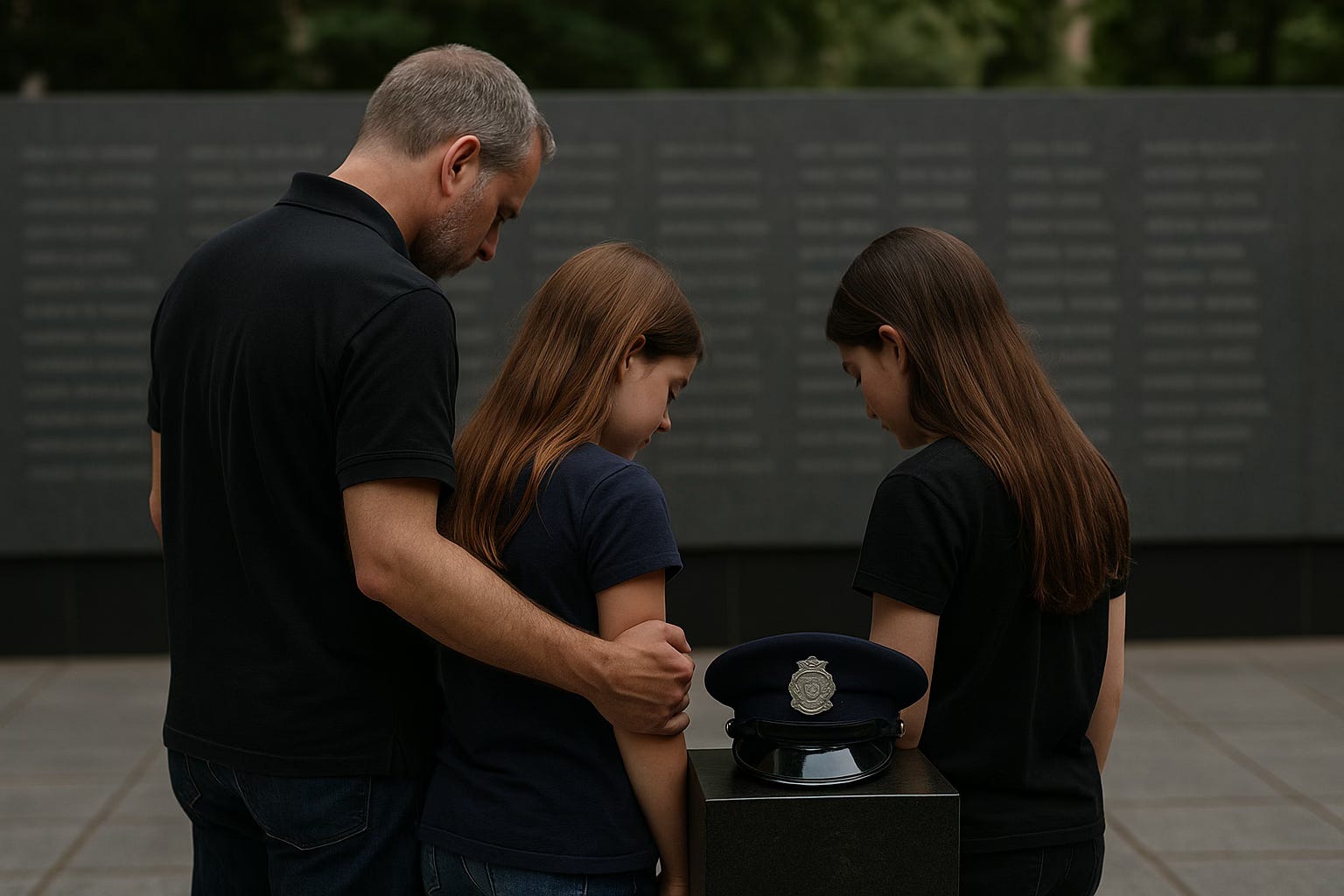
On June 22, 2025, my family and I attended the Ontario Police Suicide Memorial in Toronto. It was an emotional, somber, and profoundly necessary tribute to those who have lost their lives because of the line of duty. I’d never heard that phrase before. I teared up each time it was spoken during the ceremony.
My first wife, Cindy, will be honoured next year. But it felt important to be there this year, standing alongside other families who carry similar losses. A community no one wants to be part of, is better than no community at all.
It goes without saying that when a police officer dies by suicide, the families left behind carry a heavy burden. Over the years, I’ve heard many people acknowledge that truth. I’ve also noticed how often it’s spoken about in vague, abstract terms.
Words that gesture toward our pain without truly naming it.
“They have to find a way forward without them.”
“The family carries this loss every day.”
“Their world was changed forever.”
“They’ve been through so much.”
These phrases are well-intentioned and spoken with genuine empathy and compassion. But they seem to keep the brutal reality at an arm’s length. I think we need to name the families’ experience for what it really is. Not to seek sympathy, but to foster understanding. Because the impact isn’t temporary. It’s intergenerational.
My daughters were five and six years old when they lost their mother to suicide. She’d been a police officer for twelve years at the time of her death. Her last years were spent in a downward spiral of severe mental health issues that inexorably destroyed her life.
Cindy was a complex human being whose life was shaped by the trauma she experienced. She suffered serious physical and possibly sexual abuse as a child. She was often abandoned by her schizophrenic mother. She wrestled with an eating disorder in her teens and early twenties.
Like most first responders, she experienced ongoing trauma on the job. Horrific traffic accidents, death notifications, violent or dangerous encounters with deeply troubled people. Sometimes, PTSD is caused by a single incident and sometimes it’s an accumulation of many. We all have a limit and too often the job pushes people past theirs.
Cindy’s story is a classic example of the wounded healer. She entered policing not in spite of her early trauma, but largely because of it. Like many first responders, she carried a drive to protect others from the kind of pain she had known too well. That same unresolved trauma left her more vulnerable to being re-traumatized. Cindy’s death wasn’t the result of one moment or one choice. It was the final chapter in a lifetime of surviving without enough support and healing.
On March 26, 2010 she took her life at thirty-eight years old. She’d given all she had to give. She’d fought her demons to the death. In the end, I know she wanted to free herself from her unyielding misery. And she wanted to free us from the chaos and heartbreak of her “failures” as a wife, mother, friend, and human being.
She didn’t free anyone. She inadvertently transferred her pain to the people she loved most.
I found out she died at 11:45 PM when her co-workers showed up, pounding on my door. I spent the next eight hours wondering how I was going to tell my little girls their mother was dead. They were five and six years old and Cindy’s death shattered their beautiful, tender souls.
When I sat them down and told them that Mommy was in heaven, they just stared back at me in silence. My younger daughter spoke first when she asked, “When is she coming back?”
The most important thing at that moment was figuring out which lie to tell them about Cindy’s death. She died by asphyxiating herself on the exhaust gases of her car. She’d also recently returned from a trip from India in a last ditch effort to find some kind of salvation. I told them she had jet lag from her trip and she fell asleep in her car.
I knew I’d carry the burden of having to tell them the truth one day. As they grew older this reckoning was always present, hanging like a Sword of Damocles over our lives. What would I say? How would they react? Would they resent me for lying to them for so long?
Over the coming weeks and months the reality that their mom wasn’t ever coming back started to sink in. I comforted them countless times as they cried for Mommy and how much they missed her. The helplessness I felt was overwhelming and absolute. There was nothing I could do to take away their pain.
So I drank to drown my own.
At the time, I didn’t fully grasp the impact of the girls losing their mother and in such a traumatic way. I naively thought I could love them to healing. I even thought that, considering Cindy’s mental health issues, they might be better off this way. If I could build a new, stable, loving family then everything would turn out okay.
I was wrong.
My older daughter, Chloe, spent the rest of her life wrestling with the pain of her mother’s loss. Many of the early years seemed idyllic and almost too good to be true. I remarried a wonderful woman, we built a new life and tried to look forward.
All the while, Chloe’s trauma was invisibly metastasizing inside her mind and heart. As she grew up, the symptoms started making themselves more and more visible. She struggled in school, started acting out and was heading down a worrying path.
I had a very hard time seeing the situation for what it was. I’m sure it was related to the abject terror of living through another devastating experience with mental health issues. I’ve come to understand it was also the fear of not being able to save another person in my life. So I spent a long time rationalizing her behaviour away.
We found a letter she wrote to Cindy when she was sixteen years old. It was a tragic glimpse into the mind of a young woman who’d been crushed by her mom’s suicide. She eloquently described how much she loved and hated Cindy. She raged at her for leaving her behind. And she explained how she’d never felt good enough because she wasn't good enough for Cindy to keep fighting for.
My wife sent me a picture of the letter while I was at work. I sat in a conference room by myself and sobbed inconsolably as I read it. I felt furious at Cindy for causing our girls so much goddamn fucking pain.
We tried to get Chloe help and she refused, over and over. I wonder now how much I contributed to her resistance. I always wanted the girls to understand how hard Cindy fought for herself and for them. She spent five years making a superhuman effort to heal. I told them how she did every program, saw every professional, took every medication, followed every instruction and tried everything. Nothing worked and things only deteriorated.
It’s easy for me to see how Chloe might have internalized that as, “Why the hell would I do any of that? Look what it got my mom.” As the trauma ate away at her, she spiralled further and further out of control. By the end of her life, it had become utterly unmanageable.
She was living on her own. She was abusing drugs and alcohol. She spent wildly beyond her means. She weaved a web of lies to hide the reality of her life and suffering. The Groundhog Day I’d feared for so long was now a reality. It was like watching Cindy’s destruction all over again.
We took a family vacation to the Caribbean six weeks before she died. It was obvious how out of control she’d become. One night we were awoken by a phone call that she’d blacked out drunk, hit her head and been brought back to her room by strangers. I ran across the resort to her room.
And was transported back fifteen years. I wasn’t looking at Chloe splayed out on the bed. I was looking at Cindy. They looked eerily alike, down to the birthmark on their backs. And this scenario was something I lived through with Cindy too many times to count. I went into what must have been a full-blown PTSD episode. I dragged her into the shower and lost my shit. I was trying to save my wife who’d been dead for thirteen years.
She finally agreed to get help.
Forty days later she died driving drunk and stoned. She was driving like a maniac, lost control of her car, and caused a head on collision. She killed herself and almost killed four other people. It’s a miracle they all survived. The young man in the car with her came within minutes of death. He spent four months in the hospital and has undergone many, many surgeries.
In the end, her mental health challenges destroyed her, just like they destroyed her mom.
And her sister? I’d already had to tell her that her mother was dead. Now we had to tell her that her sister was dead too. The look on her face will be seared into my soul for the rest of my life.
She’s a wonderful human being who is making a wonderful impact in the world. Her story is hers to tell, not mine. But by the time she turned seventeen, she had lost both her birth mother and her sister. There are just two of us left from our original family of four. And there’s a constant, low-grade fear that something could happen to one of us.
Because if it does, I’m not sure the other one will survive it.
When a parent dies by suicide, the impact on their children is profound, lifelong, and often invisible to the outside world. My daughters were thrust into that reality before they were old enough to fully understand what death meant, let alone suicide.
Research shows that children who lose a parent this way are at significantly higher risk for depression, anxiety, PTSD, substance use, and even suicide themselves. But it’s not just about mental health diagnoses. It’s about the quiet confusion, the loss of safety, the questions that never get fully answered.
It’s about trying to build a sense of self in the shadow of a story that feels too heavy to carry but too important to ignore. The grief isn’t a chapter. They carry it with them, woven into who they are. And unless we name that reality and support them with the care they deserve, they will carry not just the loss, but the silence around it too.
There’s clear and growing research that shows that first responders die by suicide at a significantly higher rate than the general population. It’s their cumulative exposure to trauma. They experience moral injury and burnout. And too many, as in Cindy’s case, there’s sadly inadequate organization support and far too much stigma around mental health and seeking help.
We talk about service. We talk about sacrifice. We talk about duty. But we rarely talk about the full human cost of these things, not just for the ones who wear the uniform, but for the people who love them. We rarely talk about what it means to be the ones left behind, trying to piece together a life from the wreckage suicide causes. Trying to help children grow up with a sense of safety, worth, and identity while the very foundation of their world has collapsed beneath them.
Cindy didn’t die because she was weak. Chloe didn’t die because she wasn’t trying. They died because the systems meant to support them didn’t see them clearly enough, didn’t catch them soon enough, and weren’t built to hold the kind of pain they carried.
But their deaths were not solely the result of a failing system. Ultimately, healing is a personal journey, one that each individual must take for themselves. Cindy and Chloe’s paths to healing were obstructed by forces that were too powerful to overcome. However, the system, and the people within it, failed to recognize and address Cindy’s suffering, to meet her where she was. In doing so, they made her pain far greater than it ever needed to be.
The suicide memorials, and the people who create them, are vital tributes that help us honor the fallen. But honoring the fallen isn’t enough. If we truly want to make a difference, we must also fight for the living. We need to build systems that are trauma-informed, stigma-free, and deeply human. We must stop expecting first responders to be invincible and start treating their psychological injuries with the same urgency we give their physical ones. We owe them that. And we owe their families, especially their children, more than silence. We owe them the love, care, and support that will help them heal.
RIP Cindy and Chloe. I love you both, and I always will. ♥️♥️
We have to fight for the living. We have to build systems that are trauma-informed, stigma-free, and deeply human.
Jason, this is so powerful and true. I’m so glad I took the time to read this morning. I think the only piece missing is God. I am in AA and will celebrate 20 years of sobriety on Saturday, and it has been filled with losses, grief, a broken heart more than once. But the God of my understanding has given me courage to share my story with anyone and everyone—even my high school seniors at school. The stigma has got to go. And we need to invite God in to give us the help we so desperately need. There are 12-step programs for people on both sides of any addiction and the codependency it creates. I can’t do this myself. I must have human support and reliance on a Higher Power. God bless you on this continued journey and keep writing—it’s so powerful!
Beautiful and heartbreaking. I'm so sorry for everything your family has been through. I hadn't thought before about the impact of work on first responders' mental health. Thanks for raising awareness.